
If ever a story defied categorisation and deconstruction, here it sits!
Luxuriously lyrical and peopled by a huge cast of cacophonous eccentrics, such that the reader cannot begin to keep track of each one, it is as if Angela Carter went to every length to make her tale as chaotic and exceptionally unbelievable as possible. Above all else, it celebrates the ridiculous and the unexplainable, the surreal and the dazzlingly grotesque.
 Here is evidence that plot need not follow a clear arc, and that characters need not be realistic, let alone likable. She gives us the vulgar and the ethereal, motives base and sublime. Beribboned in silk and velvets, her dark world of magnificent misfits and baroque tragedy is fascinating, as only the truly bizarre can be. It is an outlandish, irreverent, boisterous romp.
And, at the summit of this shabbily beautiful fable is the most gaudy and bizarre character of them all: the audacious, voracious, foul-mouthed, star-spangled, gloriously sexual, Fevvers. Acrobat extraordinaire, half-woman half-bird, she charms the crowned heads of Europe, the great, the good and the very, very bad.
We only gradually gain a sense of Fevvers’ true individualism, revealed stage by stage, to find that it derives not from her wings, but from her irrepressible spirit, even to the last pages, as she stumbles through snowy Siberia. We first join her as an adored spectacle with the Cirque de’Hiver, and then tumble through her terrible past: through her childhood as a ‘winged tableau’ in a Victorian brothel, and years as an unhappy exhibit in the Museum of Women Monsters, then into the perverse hands of a millionaire who wishes to sacrifice her miraculous being in pursuit of immortality.
 Even Fevvers’ voice cannot be strictly categorised, being described as ‘dark, rusty, dripping and swooping’, ‘cavernous’ and ‘somber’, the voice of a ‘celestial fishwife’, ‘musical’ yet discordant, ‘that clanged like dustbin lids’.
Meanwhile, rather than creating ‘another love story’ (love being at the heart of her tale) Angela Carter swoops from one madcap adventure to the next, hardly giving you time to process what you have read. Besides traditional male-female romantic love, Carter bestows her caress upon love between women: downtrodden Mignon is so tenderly drawn as she falls in love with the lion-tamer princess. We see also love between Fevvers and her long-suffering adoptive mother, ever-loyal Liz, and love between circus trainers and their animals: the apes, the tigers and the noble elephants.
Such is the exuberant originality of ‘Nights at the Circus’ that to analyse its meandering plot or character development would be pointless. Every sumptuous detail is a delight, every line a masterpiece, every paragraph a sculpted work of art: here is its magic.
Fevvers’ room is a place of ‘exquisitely feminine squalor’, with ‘a large pair of frilly  drawers fallen where they had been light-heartedly tossed’, and a corset poking from a coalscuttle like ‘the pink husk of a giant prawn emerging from its den, trailing long laces like several sets of legs’. A stale feet smell emanates from ‘a writhing snakes’ nest of silk stockings’; ‘essence of Fevvers’ clogs the room. And the lady herself, in her ‘bonnefemmerie’ thinks nothing of letting ‘a ripping fart ring around the room’ for no more than the pleasure of seeing her male companion’s discomfort.
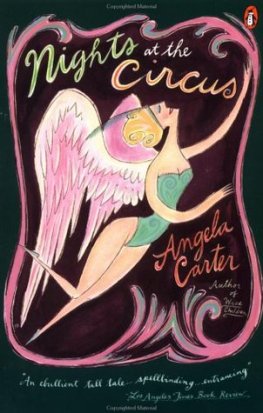 There are morals interwoven through the divinely diabolical set pieces, but do not read Angela’s Carter’s majestic masterpiece to ponder on human nature. Read it to be seduced by a deeply enchanted love affair with language.


 “There is a deceptively relaxed quality to
 Emmanuelle de Maupassant